
Finding Inspiration After Significant Loss

We will, at some point in our lives, experience trauma and loss. Very likely, it will happen multiple times. The longer we live, the more opportunities for loss we encounter. Whether it’s the dissolution of a relationship, the death of a friend or family member, a life-changing accident or illness, or some other catastrophic event, we will all face this reality at some point.
Trauma events can have a serious impact on our mental health, positivity, creativity, and perception of the world. These impacts can last for days, months, years, or change us fundamentally for the remainder of our lives.
It can be difficult to find hope and inspiration or tap into your creativity when life is in the process of beating you down. You simply don’t have the bandwidth or the energy to make something new when you constantly feel like you’re being hit from all directions.

The irony is, that’s when creativity can help you the most.
If you read my post The Science of Creativity (March 2024), you’ll remember that I posit that human beings are inherently creative by nature. We spend our lives building things—buildings, cities, communities, families, art, wealth, legacies… As a matter of fact, the opposite of creativity is destructivity, which is also the nature of most evil acts (if you believe M. Scott Peck, author of The Road Less Traveled, which he explores in his lesser-known book People of the Lie). That means, that to feel fulfilled, we need to create. And for artists, that’s typically through creating new works of art (music, screenplays, manuscripts, paintings, plays, sculptures, etc.) And yet, at the moment when life is hardest, we tend to stop creating completely.
I came across an interesting concept that shows how nature deals with this very thing. Since our human nature is intricately intertwined with Mother Nature, I felt it applies here.
Did you know that there is a group of plants referred to as ‘fire followers?’ The fire poppy (Papaver californicum) is one. It lies dormant for years, even decades. Only a wildfire creates the right environment for the fire poppy to finally grow and blossom. The poppy requires the perfect combination of smoke, heat, and ash, which only a wildfire can provide. Then and only then will the fire poppies bloom, covering a fire-ravaged, barren landscape in brilliant orange, crepe-like petals.
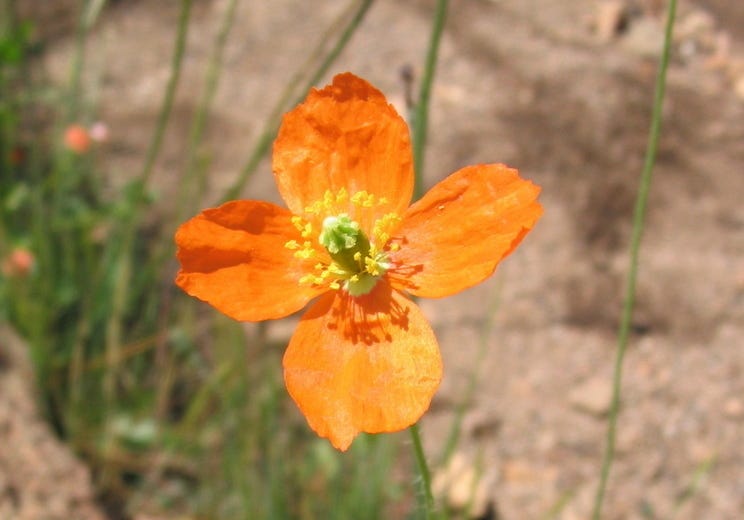
But here’s the other thing about fire poppies that’s important to note… They only bloom for 1-3 days. Then their delicate blossoms wither and retreat into the soil giving space to the plants and trees that were destroyed in the wildfire to start anew. These little flowers that are born of destruction and trauma are only temporary. They are there to fill the void for a very short time and their decay helps to bring back the life that was there before. The vegetation that was there before is what adapted and thrived and belongs there. It’s that vegetation that will come back to grow and thrive again.
Creation never stops.
When trauma has you feeling depleted of creative energy, that is the time to let the delicate fire poppies peek up and rejuvenate you. It’s okay to stop the screenplay or novel or painting that you’re working on and just be present for the rise of the fragile poppies. You can’t focus on the barren, scarred landscape ravaged by fire that’s hidden below their brilliant orange flowers. Acknowledge it’s there and see the poppies. Create. Do something creative you haven’t done before—journal or cook or sketch. Allow life to be different, grieve your loss, and use creativity to help you through the process in the way that nature uses the poppies to begin the process of regrowth. The poppies don’t last long. They’re not intended to become the new normal. They are there to serve a purpose, not take the place of the vegetation suited to live long term in the environment. Allow the poppies to wilt and die and let that break nourish your creativity again.
Nature shows us that creation never stops. And neither do fires.
The life that was there before your fire is still there. It’s waiting for the poppies to disappear so it can begin to grow again. The landscape will never look exactly like it did before the fire, but it’s still there. And it always comes back.
Christine Conradt is a director/producer/screenwriter/author who substacks about creativity and the craft and business of writing. For access to more articles, archived posts, and discounts on consulting services, consider a paid subscription.